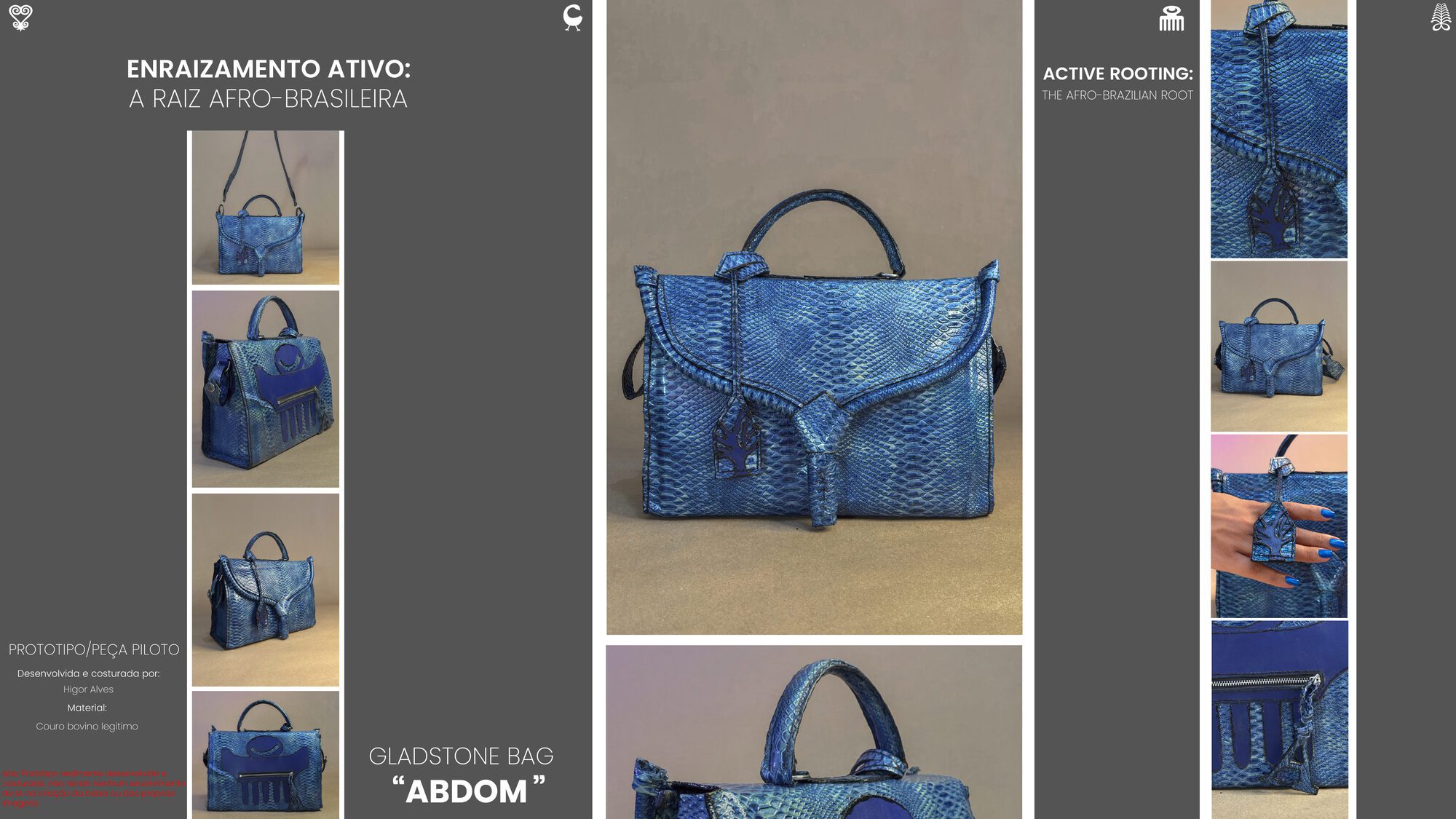
Active Rooting: The Afro-Brazilian Root
Category: Accessories
“Those who cannot remember the past are condemned to repeat it.” George Santayana (1863-1952). The project proposes a perspective on the roots of Afro-Brazilian people, understanding the past as a path of learning and reconstruction. History reveals deep marks of injustice and erasure, where many were deprived of their origins, names, and sense of belonging. This distancing created gaps in identity, leaving behind only fragments of a history often told incompletely. More than highlighting this pain, the project seeks to reframe these roots, transforming memory into affirmation. Looking back becomes an act of recognition and also of strength, allowing narratives to be rebuilt with autonomy and identity. Through a visual reading of the initial images, it is possible to perceive the depth of design present in each piece. There is a unique universe within each composition, revealed through objects, garments, jewelry, chairs, and symbolic elements such as stamps. Every detail carries meaning and builds a rich and sensitive narrative. The connection with animals and the earth appears intensely, bringing a spiritual dimension that runs through the pieces. This attentive and delicate perspective gives rise to the concept, which seeks to represent roots from a standpoint of reconnection and belonging. By entering this universe, the project establishes a dialogue with references from desert peoples, especially Saharan cultures, among others, observing their artisanal knowledge in the use of leather and textiles. From this encounter emerge constructions marked by layers, asymmetries, and organic forms, visually translating the relationship between body, territory, and identity. Other influences cross this creation and expand its meaning, such as the traditions of the Yoruba people and Adinkra symbols, which carry deep symbolic value and ancestral knowledge. Even while preserving their individualities, these cultures share connections among themselves that also resonate in Brazil—especially in the Northeast, yet present throughout the entire country—where African heritages remain alive and in constant reinterpretation. Within this process, the beauty of reconnecting with one’s own history is revealed, along with the rediscovery of roots and the affirmation of ancestry. Self-knowledge emerges as a central axis, powerfully shaped by the presence of women—essential figures in the preservation, transmission, and strengthening of these cultures over time. The union of these references gives rise to a new construction, where past and present intertwine to create something unique. More than representation, the project proposes to reaffirm identities, reframe narratives, and transform memory into a living language.
 Copy URL
 Login to Like 0