One Object, Three Lives
Category: Accessories
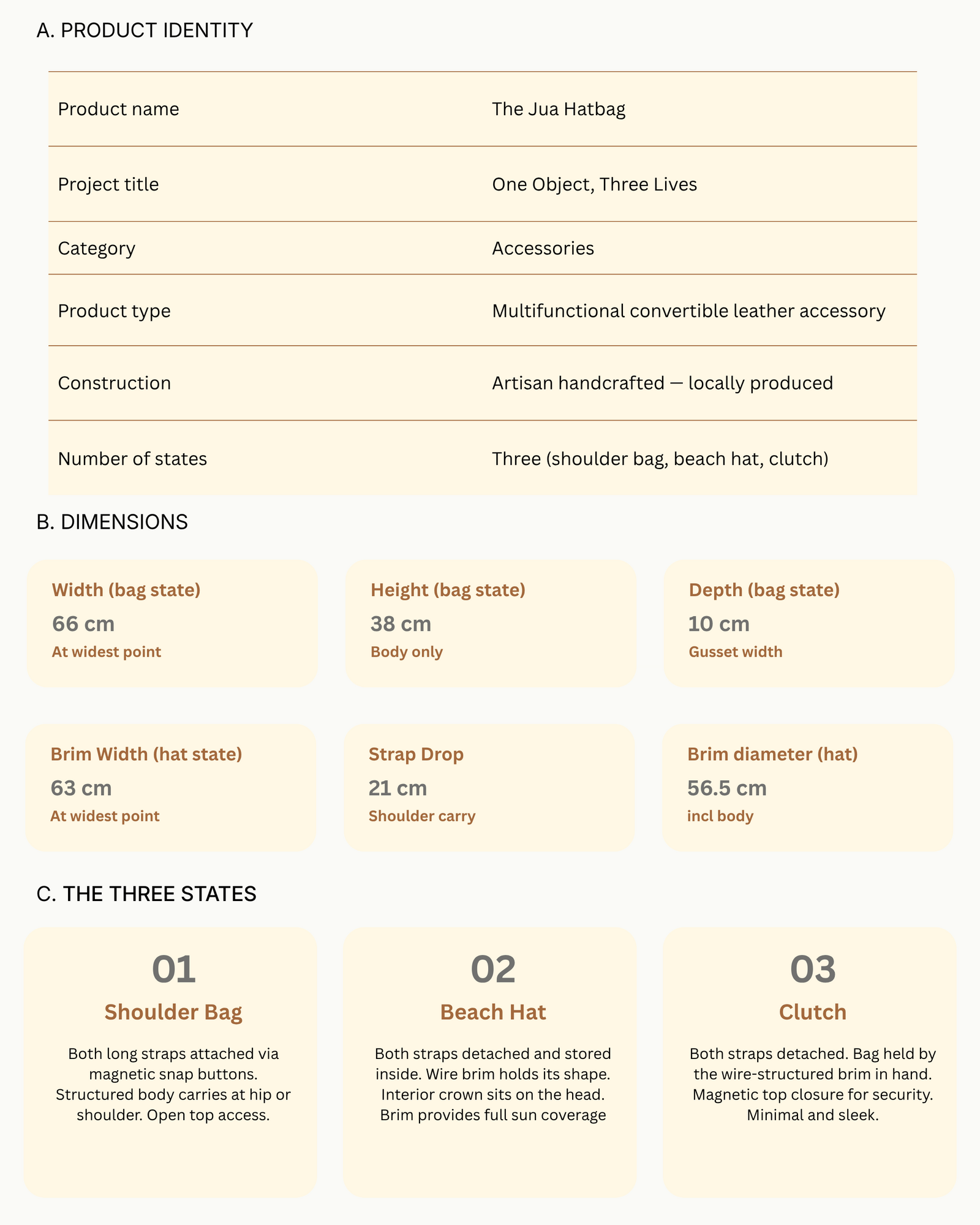
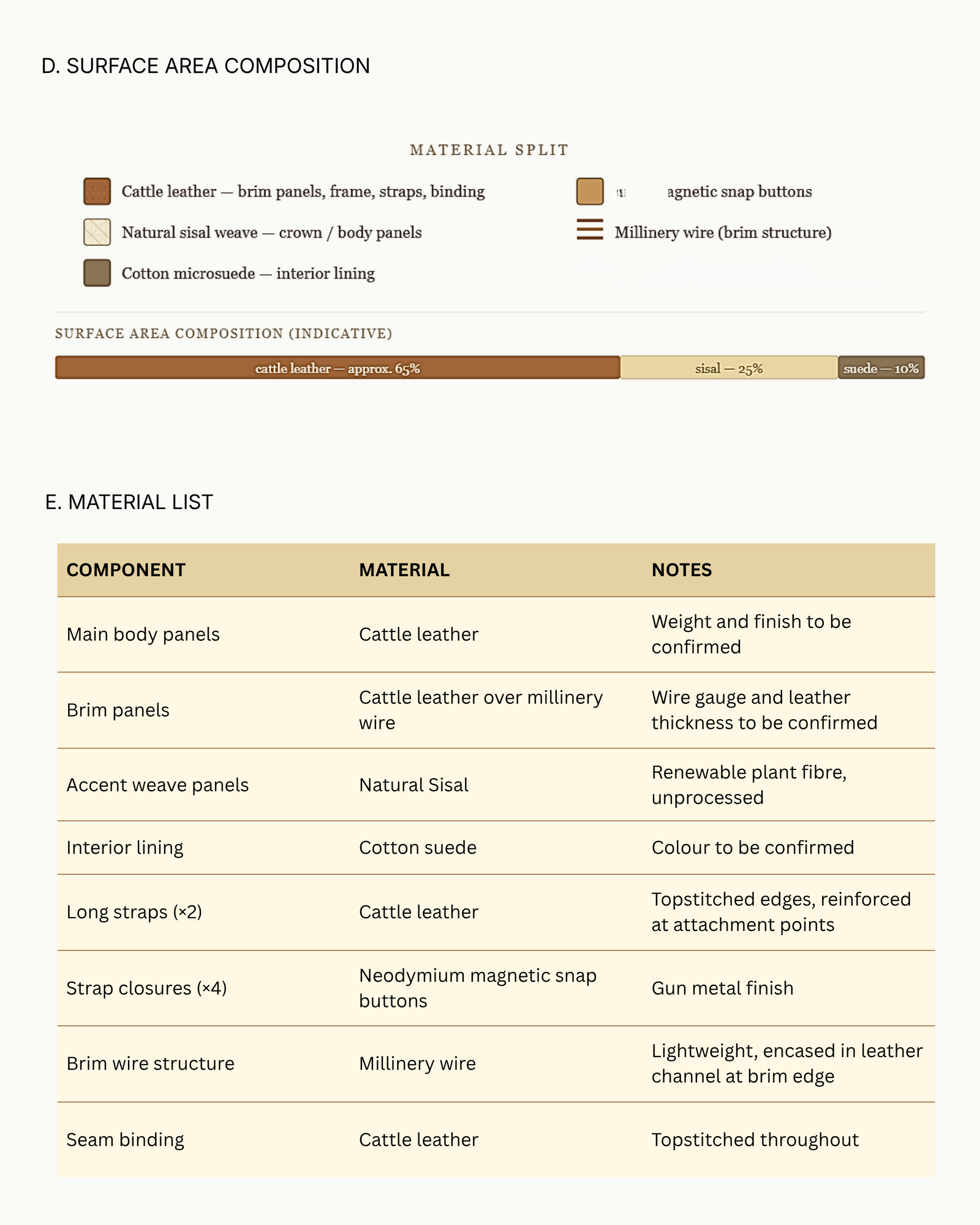
One Object, Three Lives The Jua Hatbag BY LUXALTRA Project Summary It started with a suitcase, standing in front of an open bag before a trip to the coast. I counted three separate items competing for space: a tote for the journey, hats for the beach and clutches for the evening. Three products, three production runs, three items that would eventually end in a landfill, all for a single weekend away… The fashion industry had quietly convinced me this was normal. The Jua Hatbag is my answer to that moment. Jua is the Swahili word for the sun, drawing inspiration from both the piece's coastal soul and its function: a leather accessory designed to live in the sun, to shade you from it, and to carry everything you need beneath it. Through a system of detachable straps, one object transforms between three complete states: a shoulder bag, a beach hat, and a streamlined clutch. Nothing is added. Nothing is wasted. The same piece simply shifts. This is not a novelty. It is a quiet argument against the logic of excess that defines contemporary fashion. Where the industry says "buy three" the Jua Hatbag says "own one" Where fast fashion produces disposable multiples, this piece is designed to be irreplaceable, crafted from natural materials, built to last a lifetime, and structured so that every component can be repaired or replaced independently when needed. The most radical thing a designer can do today is make something that lasts and make it beautiful enough that its owner never wants to let it go. The Jua Hatbag is designed to be that object: one piece that earns its place, trip after trip, season after season, in a world that has produced far too many items that no one needed. Sustainability A conscious approach to fashion’s waste problem The fashion industry is the second largest consumer of water globally and produces 10% of all carbon emissions. According to Greenpeace, 60% of garments are now oil-based synthetics, with the average item worn just five times before disposal. Discarded clothes pile up in waste sites from Kantamanto in Ghana to the Atacama Desert in Chile - visible, in some cases, from space. The Jua Hatbag addresses this not through marginal improvement but through a fundamental reframing: one object doing the work of three. This is the project’s central sustainability argument, and it operates across four distinct pillars. 01 - Reduction through multifunctionality The most sustainable product is the one not made. By consolidating three accessories - a shoulder bag, a beach hat, and a clutch into a single object, the Jua Hatbag eliminates two complete production cycles per customer. This means two fewer sets of raw materials extracted, two fewer manufacturing processes, two fewer items eventually discarded. At scale, the impact compounds: a run of 100 units displaces 200 products that would otherwise have been produced, packaged, shipped, and disposed of. 02 - Material responsibility Cattle leather used in this piece is sourced from hides that are by-products of the meat and dairy industries, materials that would otherwise be discarded as waste. Leather produced this way does not create new demand for animal agriculture; it recovers value from what already exists. Unlike oil-based synthetic alternatives such as PU leather and vegan leather composites, real leather biodegrades at end of life and does not shed microplastics during use. Natural sisal, the secondary material, is a renewable plant fibre harvested without chemical processing. No exotic skins, no fur, and no petrochemical-derived materials are used in this piece. 03 - Designed for longevity and repair The Jua Hatbag is built on the principle that durability is a sustainability strategy. Every component - the detachable straps, the wire brim structure, the magnetic closures, the lining is designed to be replaced independently without discarding the whole piece. A worn strap is swapped, not binned. A damaged panel is repaired by a local craftsperson, not replaced by a new purchase. This modular logic directly counters the throwaway model and extends the active life of the piece indefinitely. Leather, properly cared for, improves with age - the Jua Hatbag is designed to be more beautiful at ten years than at one. 04 - Local craft and production The Jua Hatbag is handcrafted by skilled local artisans. This production model eliminates the carbon cost of long-haul manufacturing and distribution chains, keeps economic value within the local community, and ensures each piece is made with the care and attention that mass production cannot replicate. Slow production is itself a sustainability position: fewer units made with greater intention, for owners who will keep them. End of life When the Jua Hatbag reaches the end of its usable life which, given its construction, should be measured in decades rather than seasons, its materials are designed to return cleanly to the earth. Cattle leather biodegrades naturally. Sisal fibre composts. Metal hardware can be recovered and recycled. There are no synthetic coatings, no laminated layers, and no composite materials that resist decomposition. The piece begins as a by-product and ends as nothing. Mood board and design storytelling The problem - a suitcase full of too much The fashion industry has a strange talent for making excess feel like necessity. A beach trip requires a hat. A journey requires a bag. An evening requires a clutch. Three separate objects, three separate purchases, three separate lives that almost always end in the same place: discarded. This project begins with the refusal to accept that logic. The Jua Hatbag was not designed to be clever. It was designed to make a point, that the most responsible thing a designer can do is ask whether the object they are making needs to exist at all, and if so, how much work it can do before it earns that existence. The name - what Jua carries Jua is the Swahili word for sun. It is the light that defines the East African coast. The quality of it at Lamu in the morning, at Diani in the afternoon, long and golden and unhurried. It is also the thing a good hat protects you from, the warmth a good bag travels through, the atmosphere an evening clutch is made for. The name carries the piece's geography and its function simultaneously. Every form the Jua Hatbag takes whether shoulder bag, hat, clutch is a response to a moment lived under the sun. The object does not change. The light around it does. The form - one object learning three shapes The Jua Hatbag operates through a system of detachable straps and a wire-structured brim, a millinery technique borrowed from traditional hat construction, applied to a leather accessory body. In its shoulder bag state, the long strap is attached and the structured body carries freely at the hip. Remove the strap, and the same body becomes a wide-brimmed hat, the wire brim holding its shape against the wind, the interior forming a clean crown. Close the magnetic buttons and the piece becomes a statement clutch. No additional components are needed. No elements are hidden or stored separately. The transformation is complete, and it is reversible in under thirty seconds. The Jua Hatbag is made from cattle leather and natural sisal, materials chosen not because they are fashionable, but because they are honest. Cattle leather is a by-product of the meat and dairy industries; using it recovers value from what already exists rather than creating new demand. Sisal is a plant fibre, renewable and unprocessed, that has been woven into objects of beauty across Africa for generations. Together, they produce a piece that is warm to the touch, durable in use, and entirely free of petrochemical materials. Both materials age well. Leather deepens and softens with use. Sisal develops a patina that no new object can replicate. The Jua Hatbag is designed to be more beautiful at ten years than at one, a deliberate inversion of everything fast fashion asks of an object. The craft - made by hand, made to last The Jua Hatbag is handcrafted by skilled local artisans. Every seam is reinforced. Every strap attachment point is built for repeated use, the magnetic closures tested across hundreds of open-and-close cycles, the hardware selected for longevity over cost. This is not a luxury object in the sense of being untouchable. It is a luxury object in the original sense: something made with such care that it outlasts everything around it. https://drive.google.com/drive/folders/1ClyLheMSc6FcFMweOlmzobdLQY0Qq8tp?usp=sharing
Download PDF 1 Copy URL
 Login to Like 0